As an Amazon Associate, I earn from qualifying purchases with no additional costs for you.
Trenčín lies on the Váh, the longest river flowing entirely through Slovakia, and it can boast one of the oldest written records on Slovak territory – a Roman inscription carved into the castle rock in 179 AD. Add one of the largest castles in the country, a compact historic centre and the title of European Capital of Culture 2026, and you have plenty of reasons to visit. In this article, we will show you why.
In a nutshell: Trenčín is a historic town in western Slovakia, about 1.5 hours from Bratislava, crowned by one of the largest castles in the country and home to a Roman inscription from 179 AD. In 2026 it is the European Capital of Culture. Plan 1–2 days for the town and Skalka, and up to 4 if you add the spa and nearby castles.

If you want to buy Slovak gifts or useful Slovak products, you can find them by clicking here (Amazon link).
Here is a list of places worth visiting directly in Trenčín and in its surroundings:
| # | Place | Where | Time needed | Adult ticket | Map |
|---|---|---|---|---|---|
| 1 | Trenčín Castle | in town | 1–2 h | €10–12 | map |
| 2 | Mierové Square, Štúrovo Square & Valentine the Waterman | in town | 1 h | free | map |
| 3 | City Tower | in town | 30 min | €2 | map |
| 4 | Executioner’s House | in town | 45 min | €4 | map |
| 5 | St. Michael’s Ossuary | in town | 30 min | €3 | map |
| 6 | M. A. Bazovský Gallery | in town | 1 h | €3 | map |
| 7 | County House (Župný dom) | in town | 30–60 min | depends on exhibition | map |
| 8 | Parish Church & Parish Stairway | in town | 30 min | free | map |
| 9 | Summer swimming pool on the island | in town | half a day | €12 | map |
| 10 | Roman Inscription | in town | 15 min | free | map |
| 11 | Skalka Monastery | around town | half a day | voluntary | map |
| 12 | Haluzice Gorge | around town | half a day | free | map |
| 13 | Trenčianske Teplice Spa | around town | half a day – whole day | depends on procedure | map |
| 14 | Castles near Trenčín (Beckov, Čachtice, Vršatec) | around town | half a day each | free – €8 | map |
Trenčín is a must-visit for anyone travelling to or through Slovakia. Thanks to its long history there is plenty to see in the town itself, and thanks to its location near the mountains and the Váh river, there are great places to explore just outside it.
Facts and History of Trenčín
| Region | Trenčín Region, western Slovakia |
| Population | approx. 55,000 |
| Roman inscription | 179 AD – names the place Laugaricio |
| European Capital of Culture | 2026 |
| Distance from Bratislava | approx. 125 km (about 1.5 hours) |
| Location on the map | Open in Mapy.com |
Trenčín lies in the Váh river valley in north-western Slovakia, close to the Czech border, surrounded by the Strážov Mountains, Považský Inovec and the White Carpathians. During the Marcomannic Wars between the Roman Empire and the Germanic Quadi, Roman soldiers carved an inscription into the rock below today’s castle in 179 AD, naming the place Laugaricio. For a long time it was considered the northernmost known evidence of the Romans in Central Europe.
In the Middle Ages, Trenčín is first mentioned in 1111 (as Treinchen) and 1113. It gained several privileges – in 1324 its inhabitants were freed from paying tolls, and in 1412 King Sigismund granted it the status of a free royal town. Wars and disasters followed in the next centuries; the great fire of 1790 destroyed most of the town and the castle. Trenčín flourished again in the era of the first Czechoslovak Republic. Since 1990 the historic centre has been largely restored, since 1996 the town has been the seat of the Trenčín Region, and in 2026 it carries the title of European Capital of Culture.
Useful links:
- Official website of the town – trencin.sk
- Tourist information – visit.trencin.sk
- European Capital of Culture 2026 programme – trencin2026.eu
- Local public transport – imhd.sk
Is Trenčín Worth Visiting and Is It Safe?
Definitely. Trenčín combines a long and rich history with a lively town centre, and the nearby mountains, castles and spa towns make it an ideal base for a few days in western Slovakia. As for safety, Trenčín – like the rest of Slovakia – is a safe place to visit, whether you travel solo, as a couple or with a family. Wondering about costs? Read Is Slovakia expensive to visit?.
Walk the highlights: The historic centre is compact and every sight in town (except the swimming pool) is within a few minutes’ walk. This route links them in a logical order and saves the castle for the grand finale – the last part is uphill. The whole route is about 2.5 km and takes roughly 1 hour of walking, plus time for the visits. Open the walking route in Mapy.com
Route: Bazovský Gallery → Valentine the Waterman → City Tower → Mierové Square → County House → Roman Inscription → Executioner’s House → Parish Stairway → Parish Church → St. Michael’s Ossuary → Trenčín Castle
TIP: Check out my list of recommended Slovak products. They are perfect as gifts, or you will use them during your visit to Slovakia (Amazon links)
- Slovakia Flag
- The book about Slovak History
- Slovak Travel Guide
- Slovakia Adventure Map (by National Geographic)
- T-shirt with Slovakia Flag
- Slovakia Shot Glass
- Legendary Horalky Biscuit (Original)
What to See and Do in Trenčín (Town)
Now that the basics and history are covered, let’s take a closer look at each place from the list above. At the start of each one, you will find a short overview of practical information.
1. Trenčín Castle

| Time needed | about 1–2 hours |
| Physical difficulty | easy (short uphill walk from the centre) |
| Suitable for | everyone |
| Admission (adult) | Small circuit (self-guided) €10, Large circuit (guided) €12, evening exteriors €3 |
| Getting there | on foot from the centre, or by the Matúš Čák tourist train from Palackého Street (€6 one way, €9 return; daily in June–August, weekends in May and September) |
| Official website | trencianskyhrad.sk |
| Map | Open in Mapy.com |
Trenčín Castle is the dominant feature of the town and of the whole Považie region, and it belongs among the largest castles in Slovakia. Since ancient times it guarded the trade routes connecting northern Hungary and the mining towns of central Slovakia with Bohemia, Moravia, Silesia and Poland. Its history dates back to the 11th century, when it consisted of a residential tower and a rotunda, whose remains can still be seen in the upper courtyard. At the end of the 13th century the castle became the property of Matthew Csák, who owned around 50 castles and went down in history as the “Lord of the Váh and the Tatras”. The tallest tower, Matthew’s Tower, offers beautiful views of the Váh valley.
Later owners rebuilt the castle to fit their own vision. King Louis of Anjou built the Louis Palace, which today houses an exhibition of 17th–19th century furniture. Sigismund of Luxembourg gave the castle to his wife Barbara of Cilli and built Barbara’s Palace for her. Stephen Zápoľský acquired the castle at the end of the 15th century and started extensive rebuilding – the Zápoľský Palace is the youngest of the castle palaces.
In the lower part of the castle you will find the barracks (today an exhibition of medieval and modern firearms), the Hladomorňa tower – originally an observation tower, later the castle dungeon, with an exhibition of torture devices – the cannon bastion and the famous Well of Love. According to legend, the Turkish nobleman Omar wanted to free his beloved Fatima, a prisoner of Stephen Zápoľský. Zápoľský set him a condition: dig a well through the castle rock. After three years Omar and his companions reached water, and Omar handed the first cup to Zápoľský with the words: “You have water, but no heart.”
The castle lost its military importance at the end of the 18th century, and the great fire of 11 June 1790 badly damaged both the town and the castle. In 1905 the castle passed into the hands of the town of Trenčín.
Tip: If you plan to visit several museums, the Trenčín Museum’s combined ticket (€10, valid 10 days) covers the castle (self-guided), the Executioner’s House and St. Michael’s Ossuary, as well as museum branches in Beckov and Čachtice.
Love castles? Slovakia has more castles per capita than almost any other country – see our guide to castles in Slovakia.
| My Personal Experience |
|---|
| Whichever circuit you choose, you will see why Trenčín Castle is one of the best-preserved castles in Slovakia. Kids especially love the period furniture, weapons and tools. My tip for families: in summer, take the Matúš Čák tourist train from Palackého Street – named after the castle’s most famous owner you have just read about – up to the castle. Ride up, explore, and then walk back down the covered Parish Stairway past the church (no. 8 on this list). It’s downhill all the way. |
2. Mierové Square, Štúrovo Square and Valentine the Waterman

| Time needed | about 1 hour |
| Physical difficulty | easy |
| Suitable for | everyone |
| Admission | free |
| Map | Mierové Square | Valentine the Waterman |
For centuries, Mierové Square (Peace Square) was the centre of the town’s cultural and political life, lined with burgher houses. The Jesuits built their church and college here in 1652–1657, and the square is decorated with a Plague Column, statues of St. John of Nepomuk and St. Florian, the patron saint of firefighters.
Neighbouring Štúrovo Square, named after Ľudovít Štúr, once lay outside the town walls and served as the grain market. Today it is full of shops, cafés and restaurants – and it is home to one of the town’s favourite statues, Valentine the Waterman (1998). Legend says the waterman wandered here from Moravia and fell in love with a local girl, Anna. The townspeople did not like watermen and despised their love. One night Anna’s house caught fire – Valentine rushed to the Váh and opened new springs from the ground that put out the fire. Anna survived, but the waterman did not.
| My Personal Experience |
|---|
| For me, the historic centre of Trenčín is one of the most beautiful in Slovakia – with a wonderful view of the castle and plenty of great cafés, ice cream parlours and restaurants. Its biggest advantage? Cars are not allowed on the square. People and kids can move around freely without keeping an eye out for traffic – and that goes for the whole historic centre, including the sights you are about to read about. |
3. City Tower
| Time needed | about 30 minutes |
| Physical difficulty | easy (there is a lift) |
| Suitable for | everyone |
| Admission (adult) | €2 |
| Opening hours | seasonal – e.g. 11:00–17:00 in October |
| Map | Open in Mapy.com |
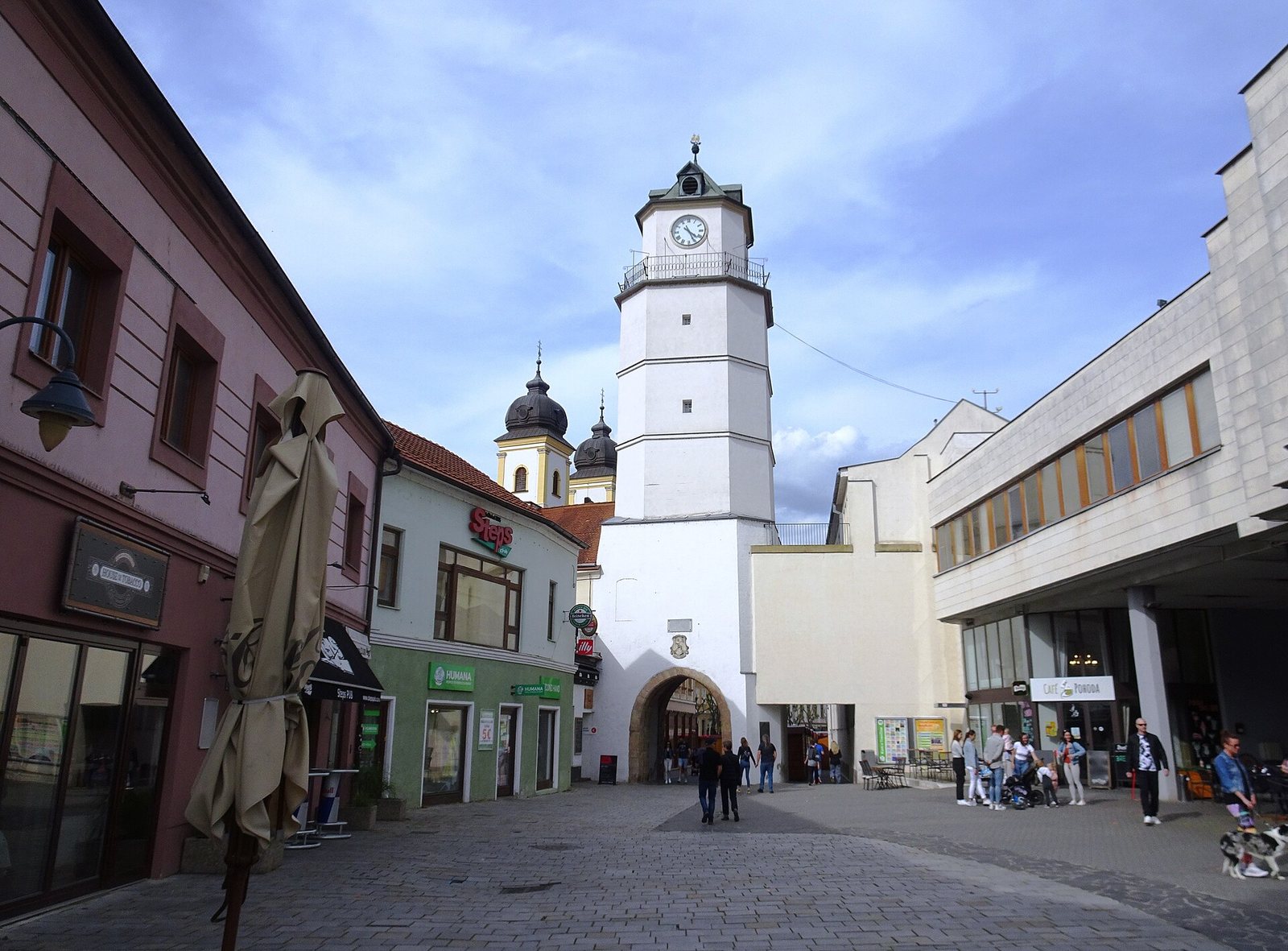
The Lower Gate, better known as the City Tower, was part of the town fortifications and has served as the western entrance to Mierové Square since the Middle Ages. It features a Gothic arch, the town’s coat of arms and a Latin inscription: “Unless the Lord guards the city, the watchman stays awake in vain.” The clock on the tower dates from 1934 and replaced the original Renaissance clockwork from the 16th century.
The climb is easy – a lift takes you up from Sládkovičova Street, and from the top you get a perfect view of Trenčín Castle, the synagogue, Mierové Square and the surrounding hills.
4. Executioner’s House

| Time needed | about 45 minutes |
| Physical difficulty | easy |
| Suitable for | everyone (some exhibits may be scary for small children) |
| Admission (adult) | €4 |
| Opening hours | April–October daily 10:00–18:00 (lunch break 13:00–13:30), closed November–March |
| Official website | muzeumtn.sk |
| Map | Open in Mapy.com |
If you are curious how law, justice and order worked in medieval Trenčín, visit the Executioner’s House. As the name suggests, it was once home to the town executioner, whose services Trenčín used until 1790. The ground floor served as a prison and a place where people were cruelly tortured, while the executioner lived upstairs. Today the house holds an exhibition of the Trenčín Museum about torture tools and medieval punishments. They say the house is haunted – ask the guide to tell you the story.
5. St. Michael’s Ossuary

| Time needed | about 30 minutes |
| Physical difficulty | easy (spiral staircase) |
| Suitable for | everyone |
| Admission (adult) | €3 |
| Opening hours | April–October daily 10:00–18:00 (lunch break 13:00–13:30), closed November–March |
| Official website | muzeumtn.sk |
| Map | Open in Mapy.com |
Below Trenčín Castle, next to the Parish Church, stands an intact Gothic building – the Ossuary (Karner) of St. Michael. It was built in the 15th century, and its rear wall is connected to the original town fortifications. Later it served as a chapel and, in the 17th century, as an armoury. Today a spiral staircase leads down into the underground ossuary, and the building also houses an exhibition of sacral art from the Gothic and Baroque periods from the collections of the Trenčín Museum.
6. M. A. Bazovský Gallery
| Time needed | about 1 hour |
| Physical difficulty | easy |
| Suitable for | everyone |
| Admission (adult) | €3 |
| Opening hours | Tuesday–Sunday, closed on Mondays |
| Official website | gmab.sk |
| Map | Open in Mapy.com |
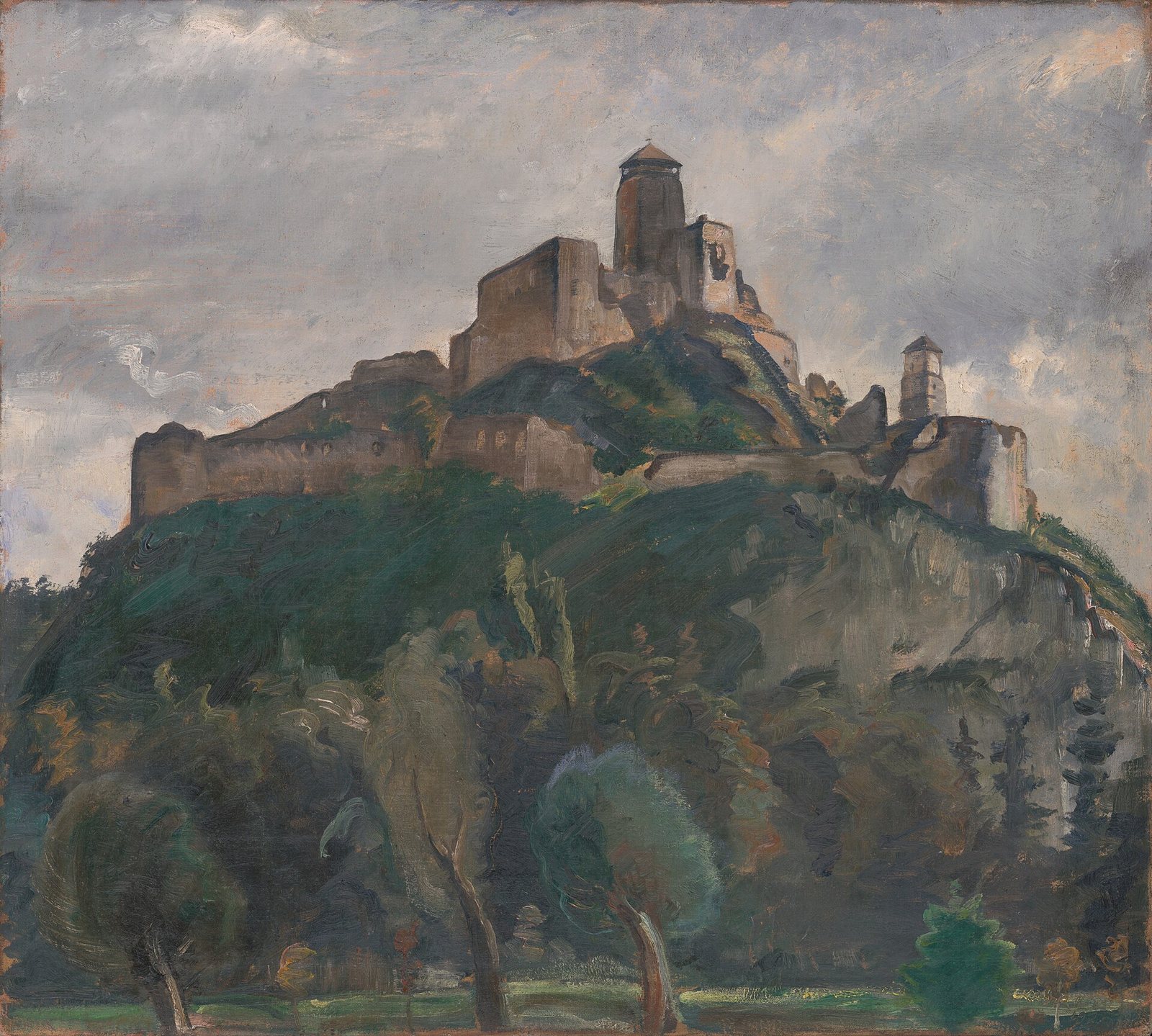
Trenčín is the centre of the Považie region not only geographically but also culturally. The Miloš Alexander Bazovský Gallery is housed in a 19th-century building that was originally a Jewish residential house. The gallery focuses on Slovak visual art of the 20th and 21st centuries and has a permanent exhibition of the painter M. A. Bazovský, one of the founders of modern Slovak painting.
7. County House (Župný dom)

| Time needed | 30–60 minutes |
| Physical difficulty | easy |
| Suitable for | everyone |
| Admission | depends on the current exhibition or event |
| Opening hours | Wednesday–Sunday 10:00–18:00 |
| Map | Open in Mapy.com |
The late-Baroque County House on Mierové Square is, after the castle, one of the most valuable historic buildings in Trenčín. For decades it was the main seat of the Trenčín Museum. After an extensive reconstruction for the European Capital of Culture 2026 it reopened in August 2026 as a cultural and community space with exhibition halls and galleries for contemporary art. Check what is on before your visit – the programme changes regularly.
8. Parish Church and Parish Stairway

| Time needed | about 30 minutes |
| Physical difficulty | easy (stairs) |
| Suitable for | everyone |
| Admission | free (voluntary donation) |
| Official website | visit.trencin.sk |
| Map | Parish Church | Parish Stairway |
Close to the castle stands the Parish Church of the Nativity of the Virgin Mary, one of the oldest and most valuable sacral buildings in town. Together with St. Michael’s Ossuary, the parish office and the former armoury, it was part of the town fortifications protecting the access road to the castle. The church was built in 1324 on the foundations of a 13th-century building. It burned down during the siege of 1528 and was rebuilt in 1553–1560 by the Italian builder Tobias Sebastiano. It was damaged by fire several more times; after the fire of 1886 it was rebuilt into its present form.
The covered Renaissance Parish Stairway was built in 1568 as a defensive passage for the town guilds who defended the walls between the ossuary and the castle. Today it is the most atmospheric way to climb from the centre up to the church, the castle and the Brezina forest park.
9. Summer Swimming Pool on the Island

| Time needed | half a day |
| Physical difficulty | easy |
| Suitable for | everyone |
| Admission (adult) | €12 day ticket (cheaper for Trenčín residents) |
| Season | June–August |
| Map | Open in Mapy.com |
The town’s summer swimming pool lies on an “island” between the Váh and the Kočkovský channel, just a short walk from the centre. It has four pools – a 25-metre swimming pool, a children’s pool, a recreational pool and a splash pool with water slides – plus plenty of grass for sunbathing, all with a view of Trenčín Castle.
10. Roman Inscription

| Time needed | about 15 minutes |
| Physical difficulty | easy |
| Suitable for | everyone |
| Admission | free |
| How to see it | through Hotel Elizabeth (reception open 24/7), 2nd floor |
| Map | Roman Inscription | Hotel Elizabeth |
Almost 2,000 years ago, Roman soldiers were present in the territory of Trenčín. The proof is an inscription carved into the castle rock in 179 AD to commemorate the Romans’ victory over the Germanic Quadi. It is one of the few Roman written records confirming the presence of Rome in Central Europe and the most important Roman inscription north of the Danube still preserved in its original place. No need to search for a translation: “To the victory of the emperors and the army of 855 soldiers of the Second Legion stationed at Laugaricio. Made by order of Marcus Valerius Maximianus, legate of the Second Auxiliary Legion.”
To see the inscription, go into the historic Hotel Elizabeth at the eastern end of Mierové Square, walk through the lobby and go up to the second floor – you can read the inscription and take a photo through a glass wall.
| My Personal Experience |
|---|
| Anything connected with the Roman Empire is a treat for history lovers, and this inscription is no exception. My tip: come after dark. The rock is beautifully lit at night, and the inscription looks even more impressive. |
Places to Visit Around Trenčín
11. Skalka Monastery

| Time needed | half a day |
| Physical difficulty | easy |
| Suitable for | everyone |
| Admission | voluntary (you can buy small souvenirs to support the site) |
| Opening hours | April–October (July–August Tue–Fri 10:00–17:00, Sat–Sun 10:00–19:00), closed November–March |
| Distance from Trenčín | approx. 5 km |
| Official website | putnickemiestoskalka.sk |
| Map | Veľká Skalka | Malá Skalka |
Skalka is the oldest pilgrimage site in Slovakia, associated with the hermits St. Andrew-Svorad and St. Benedict. It consists of two places. Malá Skalka has a small two-towered Romanesque church, first mentioned in 1208. Even more impressive is Veľká Skalka, where the Benedictine abbey founded in 1224 clings to the rocks above the Váh. The complex includes underground corridors and the original hermit’s cave, considered the oldest accessible cave in Slovakia.
Veľká Skalka is a national cultural monument with a guide service during the season. The two places are connected by the 2.2 km Malá–Veľká Skalka nature trail through the forest.
| My Personal Experience |
|---|
| If you can borrow a bike, cycling is the best way to get to Skalka on a nice day – a lovely cycle path along the Váh takes you there. Just check the monastery’s opening hours before you go. What makes the visit special for kids and adults alike is the story of the two hermits who lived here: St. Andrew-Svorad and St. Benedict, considered the first saints connected with the territory of today’s Slovakia (they were canonised in 1083). Their story was written down already in the 11th century by Bishop Maurus, who knew them personally. After Svorad’s death, Benedict stayed on alone in the cave. Robbers, convinced he was hiding money, dragged him out, killed him and threw his body into the Váh. People searched for him in vain – but for a whole year an eagle sat on the riverbank, as if watching over something. When Benedict’s body was finally pulled out of the water a year later, it was completely intact, as if he had died only a moment ago. The two-towered church at Malá Skalka stands where he was thrown into the river, and the Benedictine monastery of Veľká Skalka grew up around the hermits’ cave. |
12. Haluzice Gorge

| Time needed | half a day |
| Physical difficulty | easy |
| Suitable for | everyone |
| Admission | free |
| Distance from Trenčín | approx. 25 km |
| Start | parking at the municipal office in Haluzice |
| Map | Haluzice Gorge | Romanesque church |
Haluzice Gorge is not a typical tourist magnet full of crowds – this lesser-known gorge hides surprising natural beauty. The natural monument near the village of Haluzice was carved by the Haluzický creek; it is about 1 kilometre long with walls up to almost 50 metres high, and in summer it feels like a small jungle. Above the gorge stand the ruins of the Romanesque Church of All Saints from the 12th–13th century, and on nearby Hájnica hill a small wooden lookout tower offers views of the church and the surrounding villages. You can drive straight to the village, but we recommend walking from neighbouring Trenčianske Bohuslavice.
13. Trenčianske Teplice Spa

| Time needed | half a day to a whole day |
| Physical difficulty | easy |
| Suitable for | everyone |
| Admission | spa park free; pools and procedures priced separately |
| Distance from Trenčín | approx. 15 km |
| Official website | kupele-teplice.sk |
| Map | Hammam | Zelená žaba |
Trenčianske Teplice is one of the most visited spa towns in Slovakia, set in a green valley north-east of Trenčín. The spa is famous for its natural warm sulphur water, used especially for treating diseases of the musculoskeletal system. Its jewel is the Hammam – a Moorish-style Turkish bath built in 1888, with domes, ornate tiles and a marble fountain. You can visit it on a guided tour (on Tuesdays) or enjoy it as part of a spa procedure.
Above the town, the functionalist open-air pool Zelená žaba (“Green Frog”), built in the 1930s by architect Bohuslav Fuchs, has thermal water at around 28 °C and a sauna world open all year. You can come for a single day or stay in one of the spa hotels; the spa park and forest paths are perfect for a relaxing walk. Looking for more places like this? See our list of the best Slovak thermal parks and hot springs.
| My Personal Experience |
|---|
| If you love healing springs, Trenčianske Teplice is the place for you. I go there every year, and my favourite is a bath in the Turkish Hammam – it is unbelievably beautiful inside. In summer I also recommend the Zelená žaba pool above the town. It is small, but set in gorgeous nature with fantastic views. |
14. Castles near Trenčín: Beckov, Čachtice and Vršatec

| Time needed | half a day for each |
| Physical difficulty | easy to moderate (uphill walks) |
| Suitable for | everyone |
| Admission (adult) | Beckov €8 (March–October), Vršatec free, Čachtice currently closed |
| Distance from Trenčín | Beckov approx. 25 km, Vršatec approx. 35 km, Čachtice approx. 45 km |
| Official websites | Beckov | Čachtice |
| Map | Beckov | Čachtice | Vršatec |
There are many castles within an hour’s drive of Trenčín, so we have picked the best of them for you.
Beckov Castle
Beckov Castle rises on a steep rock above the village of Beckov. Its history goes back to the 12th century, when the castle is mentioned by an anonymous chronicler. In the 14th century it belonged to Matthew Csák – the same lord who owned Trenčín Castle – who rebuilt it to strengthen its defences.
Čachtice Castle
Čachtice Castle was founded in the first half of the 13th century as one of the first castles guarding the western border of the Kingdom of Hungary. It is best known for the legend of the “Blood Countess” Elizabeth Báthory.
Good to know: Čachtice Castle is closed from 5 October 2026 until further notice because of reconstruction works. Check the official website before you go.
Vršatec Castle
Vršatec is one of the highest-lying castles in Slovakia, surrounded by inaccessible limestone cliffs – a typical impregnable medieval guard castle that, together with other castles, protected the north-western border of Hungary. When you visit, take a short walk around the Vršatské bradlá limestone formations in the White Carpathians.
| My Personal Experience |
|---|
| Every castle around Trenčín has a fascinating history – and I have visited all of them. Beckov is especially interesting right now, because volunteers from a local civic association are restoring it step by step, with a lot of hard work and real care. |
Best Time to Visit Trenčín and Events
Trenčín is worth visiting all year round, and 2026 is a special year – the town is the European Capital of Culture, with hundreds of exhibitions, concerts and festivals throughout the year.
| Season | What to expect | Events |
|---|---|---|
| Spring (April–May) | Museums and the castle open for the season, pleasant weather for Skalka and Haluzice | – |
| Summer (June–August) | Peak season, the summer swimming pool is open, longest opening hours | Pohoda – one of the largest music festivals in Central Europe (July, at Trenčín Airport) |
| Autumn (September–October) | Colourful forests around the castles, fewer visitors | Last weeks of the museum season (most close at the end of October) |
| Winter (November–March) | Quiet town, Trenčianske Teplice spa is perfect for cold days; some museums closed | Christmas markets on Mierové Square (from late November / early December) |
The highlight of the summer is Pohoda, a multi-genre music festival held every July at Trenčín Airport, which attracts tens of thousands of visitors from all over Europe. In 2026, the European Capital of Culture programme adds festivals, exhibitions and events all year long – check trencin2026.eu for what is on during your visit.
Our tip: late May, June or September offer the best combination of good weather, open museums and fewer crowds. If you love Christmas atmosphere, see also our guide to the best Christmas markets in Slovakia.
How Many Days to Spend in Trenčín
One full day is enough for the town centre and the castle. Plan 2 days if you add Skalka, and 3–4 days if you also want to enjoy the spa in Trenčianske Teplice and explore the castles and nature around. To get the most out of the surroundings, we recommend renting a car.
| Day | Suggested plan |
|---|---|
| Day 1 | Walking route through the centre: Roman Inscription, Mierové Square, City Tower, Executioner’s House, Parish Stairway and Church, Trenčín Castle |
| Day 2 | Skalka Monastery in the morning, afternoon and evening in Trenčianske Teplice (Hammam, Zelená žaba, spa park) |
| Day 3 | Beckov Castle and Haluzice Gorge, or Vršatec Castle and the Vršatské bradlá rocks |
How to Get to Trenčín
Trenčín lies roughly halfway between Bratislava and Žilina on the main D1 motorway and the main railway line, so it is easy to reach by car, train or bus. Fast trains from Bratislava take about 1.5 hours.
| From | By car | By public transport |
|---|---|---|
| Bratislava | approx. 1.5 hours (D1 motorway) – route | direct train approx. 1.5 hours |
| Žilina | approx. 1 hour (D1 motorway) – route | direct train approx. 1 hour |
| Vienna Airport | approx. 2 hours – route | bus or train to Bratislava, then train |
Flying in? The nearest international airports are Bratislava and Vienna – more in our article about airports in Slovakia.
Plan your journey: cp.sk (all trains and buses in Slovakia) | ZSSK – Slovak railways
FAQ about Trenčín
Is Trenčín worth visiting?
Yes. It has one of the largest castles in Slovakia, a compact and lively historic centre, a unique Roman inscription from 179 AD, and great trips nearby – Skalka, spa towns and more castles. In 2026 it is also the European Capital of Culture.
How many days do you need in Trenčín?
One day is enough for the town and the castle. Plan 2–4 days if you want to visit Skalka, Trenčianske Teplice and the castles around.
Where can you see the Roman inscription in Trenčín?
From the second floor of Hotel Elizabeth at the eastern end of Mierové Square. The view through the glass wall is free and the reception is open 24/7.
How much does Trenčín Castle cost?
In 2026 the self-guided small circuit costs €10 and the guided large circuit €12 for adults. A combined museum ticket for €10 also covers other museums in and around Trenčín.
Is Čachtice Castle open?
Not at the moment – it is closed from 5 October 2026 until further notice because of reconstruction works.
How do I get to Trenčín from Bratislava?
By car it takes about 1.5 hours on the D1 motorway; direct trains take about 1.5 hours as well.
Related Articles
- Banská Štiavnica: 10 Best Things to Do (Local’s Guide)
- Spiš Castle: History, Facts, Opening Hours, Prices
- Traditional Slovak Food: Tips for National Dishes
- Slovakia Wine Guide: Traditional Regions & Grape Varieties
- Slovakia by Locals: 21 Interesting, Weird & Unusual Facts
- Do Slovaks Speak English?
Photo credits
- Trenčín Castle above the old town: Scotch Mist / Wikimedia Commons, CC BY-SA 4.0 (cropped and resized)
- Trenčín Castle seen from the Váh: Ingo Mehling / Wikimedia Commons, CC BY-SA 4.0 (resized)
- Valentine the Waterman on Štúrovo Square: Noémi Alzayadi / Wikimedia Commons, CC BY-SA 4.0 (resized)
- The City Tower: Palickap / Wikimedia Commons, CC BY 4.0 (resized)
- The Executioner’s House: Patrik Kunec / Wikimedia Commons, CC BY-SA 4.0 (resized)
- St. Michael’s Ossuary: Ladislav Luppa / Wikimedia Commons, CC BY-SA 4.0 (resized)
- Trenčín Castle by Herman Kasriel, from the gallery’s collection: Herman Kasriel / Wikimedia Commons, Public domain (resized)
- The County House on Mierové Square: Andrzej Otrębski / Wikimedia Commons, CC BY-SA 4.0 (resized)
- The Parish Church with the castle behind it: Palickap / Wikimedia Commons, CC BY 4.0 (resized)
- The summer swimming pool on the island: Jetam2 / Wikimedia Commons, CC BY-SA 4.0 (resized)
- The Roman inscription from 179 AD: Unknown author / Wikimedia Commons, Public domain (resized)
- Veľká Skalka monastery: Kenad / Wikimedia Commons, Public domain (resized)
- Haluzice Gorge: Lure / Wikimedia Commons, CC BY-SA 4.0 (resized)
- The Hammam in Trenčianske Teplice: Rodolphus74 / Wikimedia Commons, CC BY-SA 3.0 (resized)
- Beckov Castle: Pudelek (Marcin Szala) / Wikimedia Commons, CC BY-SA 3.0 (resized)
Recent Posts
A local's guide to Banská Štiavnica: castles, a real gold and silver mine, mining lakes and Sitno – with my own tips, prices, opening hours and maps.
Did you know that our little big country Slovakia is filled with castles? This article focuses exactly on that. Slovakia has the most castles per capita in the world. There are over 180 castles...